🌏 Translate on top right
Status: Congealed, Over-priced, and Exhausting under Judicial Bureaucracy
Setting: The Small Claims Municipal Court to the Jurisdictional Wasteland
Identity: The Self-Represented Litigants (The Diners) vs. The Pensioned Clerks (The Chefs)
The CINOO’s Paradox
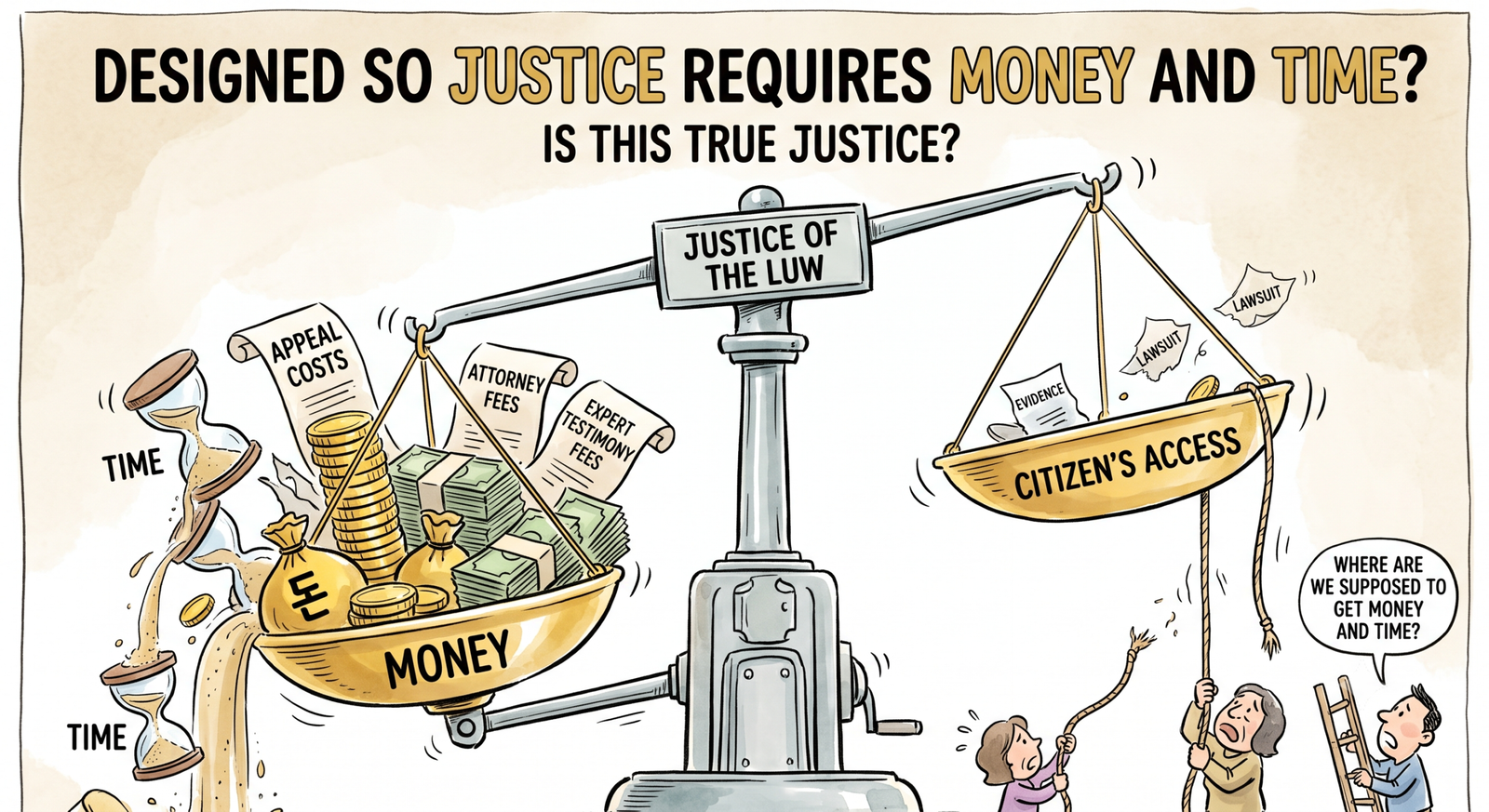
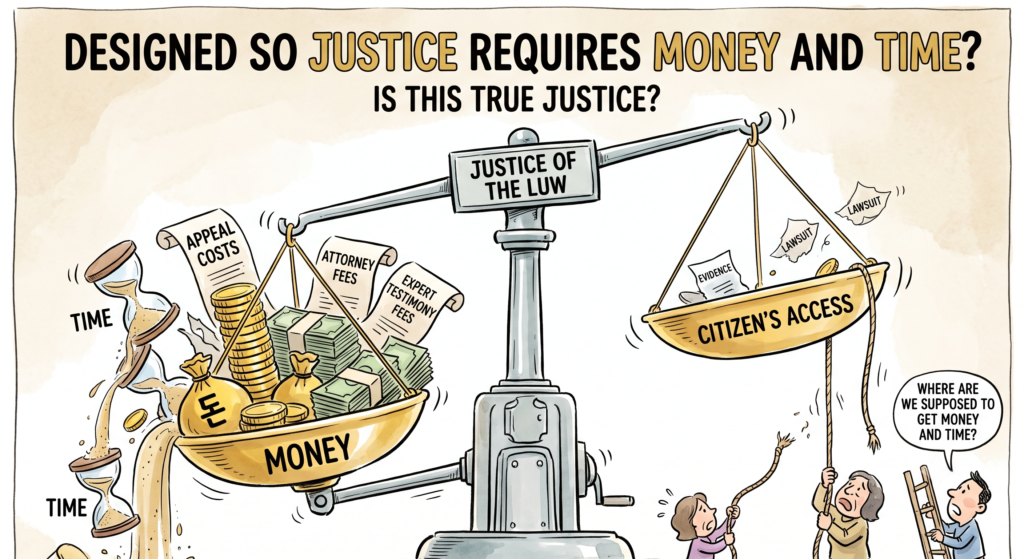
The Paradox of Institutional Relief — When judicial bureaucracy designs a legal system under the pretext of public service, it deliberately engineers administrative friction to ensure that only those with infinite time and capital can ever digest justice.
The Five Courses of Crisis
I. The Prep
Judicial system begins when court systems weaponize procedural exhaustion, turning simple small claims into an unnavigable maze of deliberate institutional silence. The court architecture does not exist to assist injured citizens against predatory landlords. Instead, pensioned clerks collect processing fees, enforce hyper-local jurisdictional silos, and sever cross-city communication channels. Public tax revenue funds a sterile theater, which operates entirely to protect its own administrative comfort. Meanwhile, self-represented litigants abandon their rightful claims midway through the process because the economic friction outweighs the remedy.
The top five percent of academic elites—the doctors, prosecutors, and judges cultivated by our flawed education system—were meant to design a civilized society. Instead, they built an intentionally chaotic apparatus designed to keep the remaining ninety-five percent confused and helpless. The average working-class taxpayer enters the courthouse under the tragic delusion that the law functions as a neutral arbiter. They bring meticulous receipts, digital photos of property damages, and hours of documented communication. Yet, the administrative apparatus views these raw facts as an unwelcome disruption to its daily routine. Consequently, the individual finds themselves trapped in a rigged game where rules shift at every clerk window.
II. The Cooking
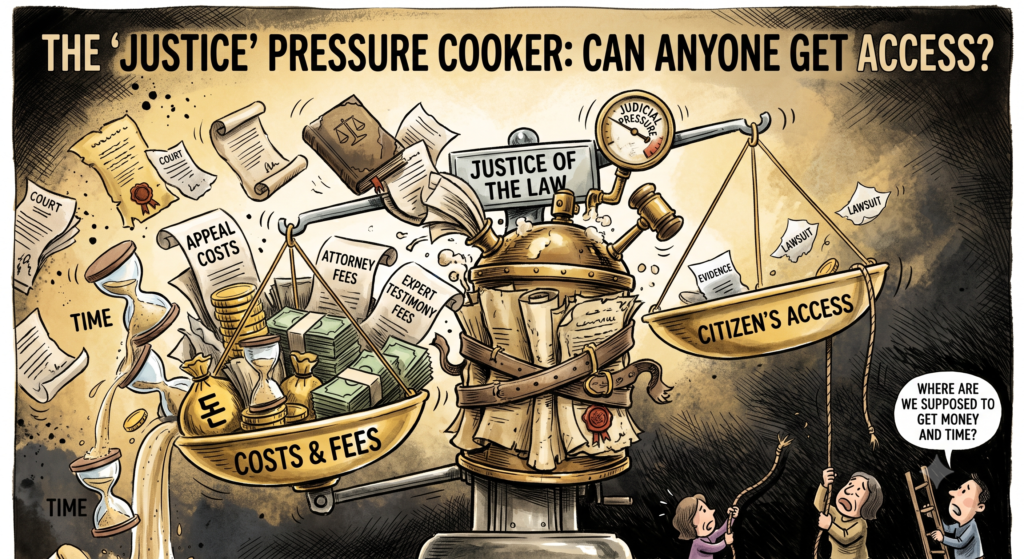
The legal stew simmers inside an archaic, paper-bound pressure cooker. Aging judges and forgetful court staff dump fresh evidence into a bubbling vat of jurisdictional technicalities. If a citizen moves across municipal lines, the system cuts the operational chain completely. They force you to repay filing fees at the next municipal counter and restart the entire nightmare from scratch. This deliberate friction melts down legitimate grievances into utter fatigue, conditioning working citizens to accept landlord extortion rather than endure another day of unpaid leave.
To add insult to injury, serving the legal notice forces you into another medieval racket. The system demands exact cash-only payments for sheriff service, providing zero tracking, accountability, or proof of operational effort. When public law enforcement fails to deliver the documents, desperate citizens turn to private process servers. Yet, these private entities often act as secondary vultures, exploiting vulnerable litigants with exorbitant fees and zero execution. Every transfer requires a new money order, another physical form printed on low-grade paper, and another morning wasted standing in line before an indifferent clerk. This engineered fragmentation boils away human agency, leaving only bureaucratic sludge.
III. The Taste
The immediate reality arrives as a cold, bitter plate of institutional hostility. Citizens stand before court clerks who hide behind strict “no legal advice” policies, leaving ordinary taxpayers completely stranded without a map. Judicial system sells the illusion of blind justice, yet it serves a luxury dining experience reserved exclusively for retainer-backed law firms. Inside the courtroom, citizens watch an exhausted, aging magistrate manage their life-altering conflicts while quietly eyeing the clock, pacing the trial around their own physical limitations and coffee breaks.
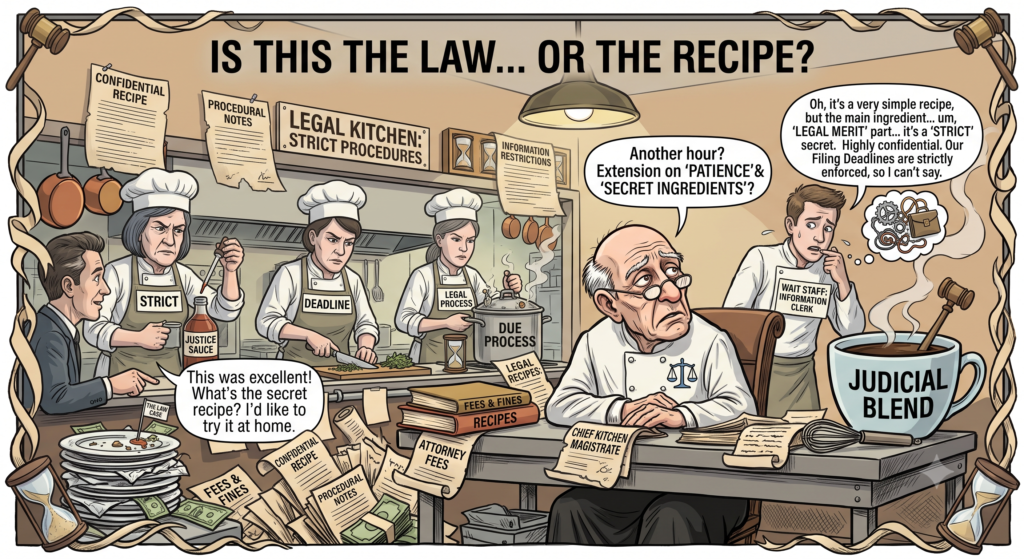
Citizens surrender their livelihoods on the docket while an elderly judge weighs evidence based on their own stamina and overtime limits. The average person quickly realizes why popular cinema endlessly glorifies vigilante justice; when official channels actively starve the innocent and convert honest taxpayers into desperate outlaws, taking matters into one’s own hands becomes the only logical survival response.
When you ask a basic procedural question, personnel stare back with practiced apathy. They refuse to clarify ambiguous field instructions, claiming that even pointing to the correct door constitutes an ethical violation. Meanwhile, high-priced corporate attorneys slide through private side entrances, exchanging familiar nods with judicial staff. The public pays for the entire facility through heavy taxation, yet receives less hospitality than a trespasser at a private estate. The taste of this system is toxic, forcing the working class to swallow economic loss simply to preserve their mental sanity.
IV. The Indigestion
The structural fallout creates a dangerous, systemic breakdown of civic trust. Because the state forces honest taxpayers into administrative dead ends, it inadvertently converts law-abiding citizens into desperate outlaws. The human spirit rejects a legal framework that prioritizes municipal fee collection and cash-only process servers over fundamental fairness. The system bloats itself on taxpayer money, while outsourcing its actual operational duties to overpaid, memory-impaired bureaucrats who treat human suffering as minor paperwork errors.
As a result, an entire generation quietly unplugs from the democratic contract. When ordinary citizens observe that small-scale extortion by property managers, utility monopolies, and financial institutions goes completely unpunished due to intentional court friction, they cease to respect the authority of the bench. The judiciary transforms from a pillar of social stability into a predatory tollbooth. This mass disillusionment brews a volatile social indigestion, driving the public to seek alternative, unmonitored avenues of dispute resolution outside the paralyzed state apparatus.
V. The Bill
Ultimately, the social contract demands a devastating reckoning. You pay the bill with your irreplaceable human time, your sanity, and your hard-earned capital, trading your faith in democracy for an empty court docket. The current administrative matrix must be dismantled, paving the way for automated artificial intelligence systems to replace biased, inefficient human clerks with transparent, zero-friction algorithmic justice.
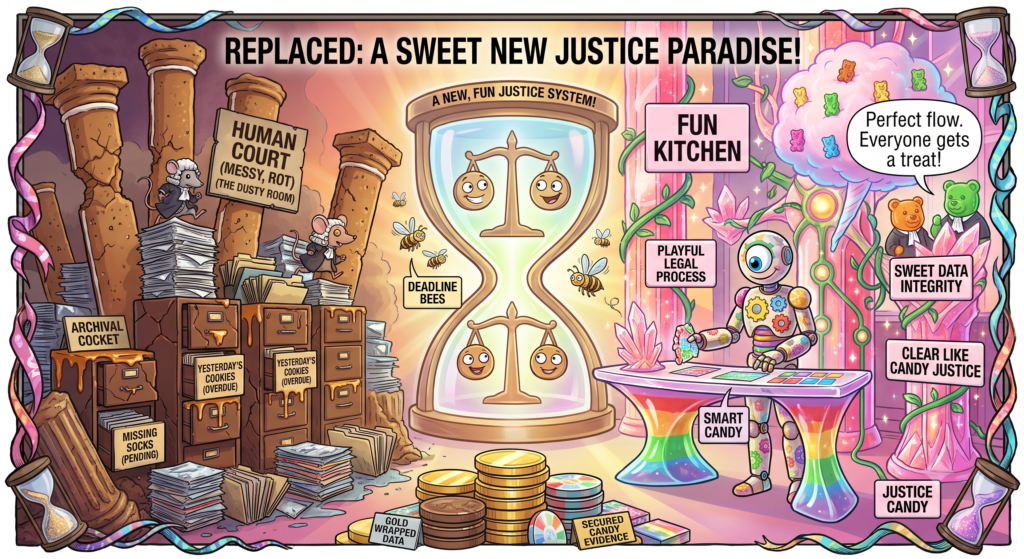
Why should a modern society rely on cash-only police couriers, predatory private servers, and aging court staff who operate on schedule templates from the nineteenth century? An uncorruptible, automated ledger can analyze lease contracts, process evidence, track delivery cryptographically, and issue legally binding small-claims rulings in seconds without charging arbitrary municipal reassessment fees. Until we systematically replace this rotting human bureaucracy with precise digital intelligence, the bill will continue to drain the vitality, wealth, and freedom of the working public.
The Final Question for Architect
Are you quietly maintaining an obsolete judicial theater that criminalizes the victim through administrative exhaustion, or are you ready to hand the scales of justice over to an uncorruptible algorithmic infrastructure?
“The court clerk never promises you justice; they merely sell you the expensive, cash-only ticket required to sit in the waiting room until you starve.”— CINOO
24:The Squeezed Citrus of Silicon Valley
26: The Frozen Pepperoni Slice and the Illusion of Career Stability
27: The Raw Truffle and the Factory Assembly Line
Which heat in your own life prepared you for the one you’re facing right now? Tell me in the comments.