🌏 Translate on top right
Status:
Over-boiled, structurally uneven, and entirely financed by the lower economic crust via the hidden cost of corporate failure.
Setting:
From the assembly lines of Wolfsburg to the communal iron pots of historical peasant kitchens.
Identity:
The Seasoned Ingredients (The Working Class) vs. The Invisible Cleavers (The Executive Board).
The CINOO’s Paradox
The structural contradiction of global civilization lies within the assembly of its most celebrated cultural triumphs, heavily masking the true cost of corporate failure. Consider the global reverence for Bibimbap, Hot Pot (Huoguo) or Arancini. Today, elite foodies pay an absolute premium for these dishes in minimalist metropolitan dining rooms. Yet, these culinary icons were entirely engineered by historical peasants out of sheer, desperate survival. They took the discarded stems, the cold leftover rice, and the cheap offal scraps to create a masterpiece.

The paradox is grim: the working class creates the entire foundational flavor of human culture, yet they are systematically forced to swallow the bitter leftovers of elite incompetence. When institutional masters miscalculate the market, they never starve. Instead, they simply dump the toxic liabilities downward, forcing the front-line line cooks of industry to pay for errors they never committed.
The Five Courses of Crisis
I. The Prep
The cost of corporate failure is quietly chopped into the budget long before the working-class workforce ever realizes the executive kitchen has ruined the recipe. Look closely at the automotive landscape. Two years ago, checking out local dealerships revealed the entry-level mid-size sedan market. Sitting inside the 2025 Volkswagen Jetta exposed a stark reality: outdated aesthetics, an uninspired interior, and technological functions stuck completely in the past. The baseline blueprints were visibly uninspired. Yet, the corporate architects locked in the design anyway, completely insulated from the financial gravity of their creative bankruptcy.
II. The Cooking
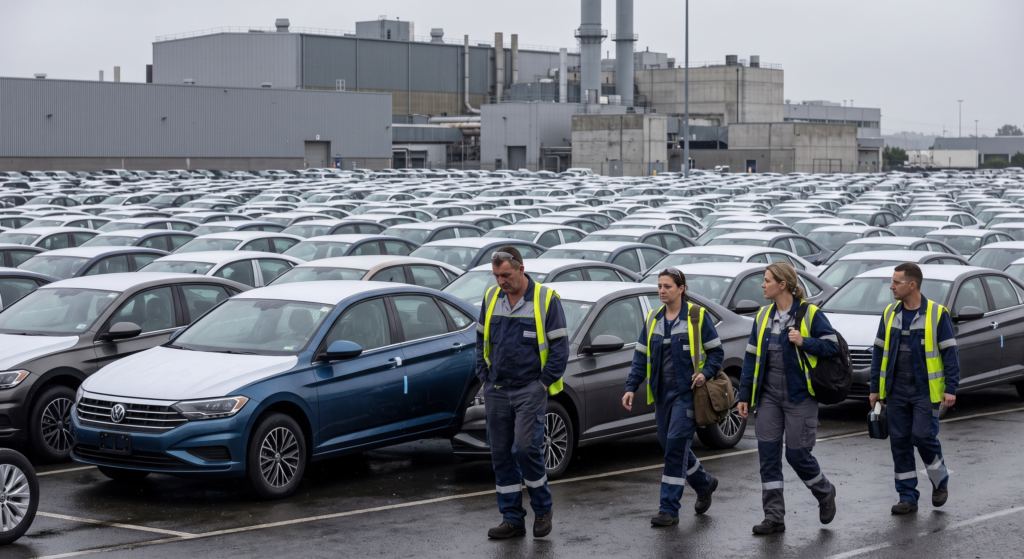
Subsequently, the institutional soup boiled over into a highly volatile labor crisis across the European industrial heartland. Executives panicked as market shares dissolved. Their immediate solution was an aggressive purge. They initiated plans to terminate over one hundred thousand dedicated factory workers. The profound irony is sickening. The assembly line laborers facing termination did not design the outdated Jetta, nor did they outline the failed corporate strategy. They simply showed up, operated their assigned stations, and executed the master plan with absolute discipline. Yet, the heat was turned up exclusively on them.
III. The Taste
However, the immediate reality of this economic dish is deeply biting, intensely ironic, and saturated with profound societal exhaustion. Everyday people find themselves consuming a highly toxic corporate culture. Executives hide behind ironclad severance packages and opaque boardroom veils, completely erasing their personal accountability. Meanwhile, the public watches the very people who built the company’s foundation get chopped out of the recipe entirely. It tastes exactly like a burnt, dry bowl of plain rice—devoid of the rich, creative ingredients that the working class originally brought to the table.
IV. The Indigestion
Furthermore, a massive structural backlash is currently simmering beneath the surface of the global technological landscape. Society is currently rushing to automate everything, foolishly believing that raw computing power will fix these deep institutional flaws. But artificial intelligence is completely useless if the foundational human structures remain fundamentally corrupted. Supercomputers cannot fix broken executive leadership or reckless greed. The economic stomach is twisting. Relying on advanced tech while preserving a broken social foundation guarantees widespread systemic stagnation.
V. The Bill
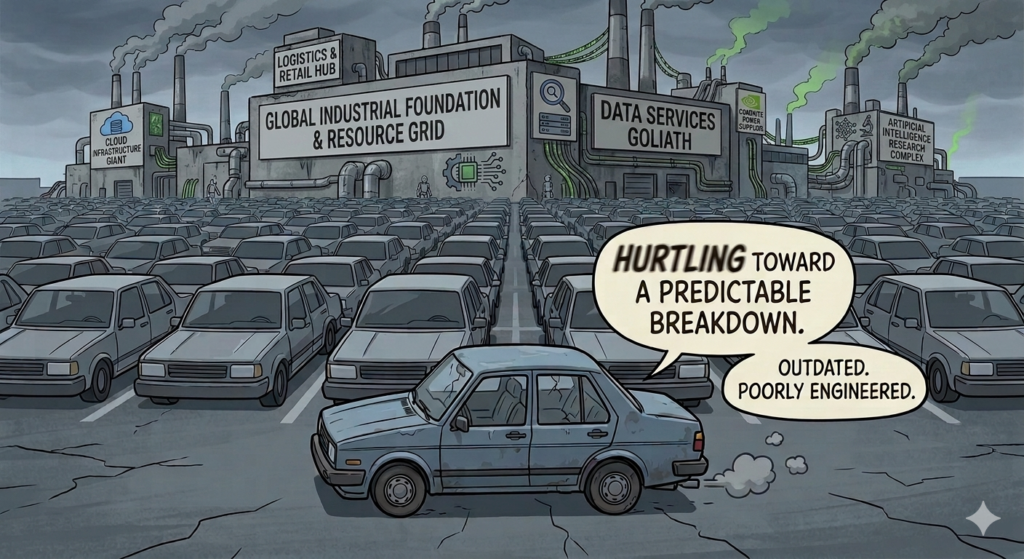
Ultimately, the final moral invoice for this institutional negligence is staggering, shifting the absolute burden directly onto the base of society. Billions of dollars in human potential are discarded to protect executive bonuses and rapidly depreciating corporate legacies. The historical creators of wealth are left holding an empty bowl, completely starved of security. We realize, with absolute clarity, that the future of our economic infrastructure looks exactly like that uninspired Jetta—outdated, poorly engineered, and hurtling toward a predictable breakdown.
The Final Question for Architect
When the corporate veil is finally torn down and the assembly lines fall silent, the question every system architect must face is stark:
“Are you building a foundation designed to uplift the hands that mix the bowl, or are you merely running an executive kitchen that fires the line cooks when the master chef burns the roast?”
“The elite design a flawed engine, but it is always the mechanic on the floor who inherits the crash.” — CINOO
19: The Institutional Hierarchy
20: The Shark Fin Soup of Tech and the Corporate Matrix
21: The Mass-Produced Leftovers
22: Statue of liberty and the Immigration matrix
Which heat in your own life prepared you for the one you’re facing right now? Tell me in the comments.